Are women in theatre free to explore their creative liberties while facing industry critics?
There is an episode of Friends, airing in 2003, in which Joey gives the other 5 tickets to one-woman-show ‘Why Don’t You Like Me?: A Bitter Woman’s Journey Through Life’. The tickets are in themselves a ruse, to keep them away from the roof party he’s throwing for the cast of his soap opera. The friends, barring Chandler, catch him out on his bluff, leaving Chandler in the theatre on his own, squirming in the front row in the face of a menstruation monologue. He has, in effect, been pranked into watching the show.
In 1994, V (formerly known as Eve Ensler) started writing about vaginas. More specifically, she asked her friends questions about their relationships with their vaginas and, in comparative unison, their relationships with sex, patriarchy and their own bodies. Not long after, she had interviewed hundreds of women from different communities about the topic. The Vagina Monologues had its first performance in 1996.
It may seem like a stretch to draw comparisons between the two, but Friends, set in New York in the late 90’s/early 2000’s, and the very presence of The Vagina Monologues across this time are mutually inclusive things. In that episode, we see Chandler squirming as the performer onstage delivers the title ‘Chapter One: My First Period’. It’s one of the most easily discoverable examples in popular media of attitudes to the female body in theatre; we can learn a lot from it. In 1999, Anita Gates reviewed a return engagement of The Vagina Monologues for The New York Times.
‘The audience at the preview performance on Friday night (far from all women) was overwhelmingly adoring, but the man to my right did seem to check his wristwatch between every monologue. For some, enlightenment comes slowly.’
Anita Gates – THEATER REVIEW; A Body Part Returns As the Leading Lady
It would be unrealistic to suggest that a Friends gag is based on a concluding line in a review from 4 years earlier, but the comparison rings true. The creative liberties of women throughout modern theatre history have often become points of conflict, something often beginning with disengagement and satire in the face of feminist art. What will, and has trickled down from this attitude, is the restriction of women’s ability to hold creative liberties and artistic vision.
Emma Rice became the third artistic director of Shakespeare’s Globe in 2016. During her two seasons in leadership, she succeeded in diversifying the organisations audiences, as well as providing higher gender equity in casting. When her departure was announced 6 months after her appointment, her work was described as ‘mould breaking’, with an acknowledgement of the ‘exceptionally strong box office returns’ she had achieved in her leadership.
Shakespeare’s Globe had at this point re-evaluated its artistic direction. Up until the beginning of Emma Rice’s leadership, it had never used masses of artificial lighting and sound, instead focusing on ‘natural light’.
The press release for Emma Rice’s appointment described it as ‘an excellent appointment, in keeping with the Globe’s traditions of boldness and adventure.’, and yet, when this boldness was shown within her work, she was shunned. Rice’s mounting of A Midsummer Night’s Dream at The Globe was described as a decision holding ‘perversity, incongruity and disrespect’. What had started as a bold leap into the technological modernisation of a historically inspired venue, became the reason for a downfall.
In the years since, Rice has spoken publicly at the lack of faith the establishment had in her as a creative.
‘Never think that my decision to step down in 2018 was simply about lights and sound, it was about personal trust and artistic freedom.’
Emma Rice in an open letter to her Globe successor, 2017
8 years on from the controversy, it is clear Rice was placed in an impossible position; the amplification of her work in this space was a trial, an opportunity for the venue to explore a new direction for its work. If it didn’t go well, she would become the scapegoat. Rice was scrutinised for an appointment others chose, her credited strengths becoming weaknesses in the eyes of the board, as well as the press.
21 years before Emma Rice’s appointment, the Royal Court premiered Sarah Kane’s debut play Blasted. Jack Tinker’s infamous headline for the Daily Mail described the play as ‘A disgusting feast of filth’, comments that rapidly spiralled and framed Kane and her work as the recipients of excessive media vilification.
‘I think it’s important not to confuse press with audience. There was media outrage, but it was never a public outcry. And as for whether the press response was to do with gender, I’m not sure. That explanation clearly can’t be applied to Edward Bond or Howard Brenton whose plays have provoked similar hostility. I suppose the fact that it’s a play about a middle-aged male journalist who rapes a young woman and is raped himself can’t have endeared me to a theatre full of middle-aged male critics.’
Sarah Kane on the critical responses to Blasted in Heidi Stephenson and Natasha Langridge’s ‘Rage and Writing: Women Playwrights on Playwrighting‘
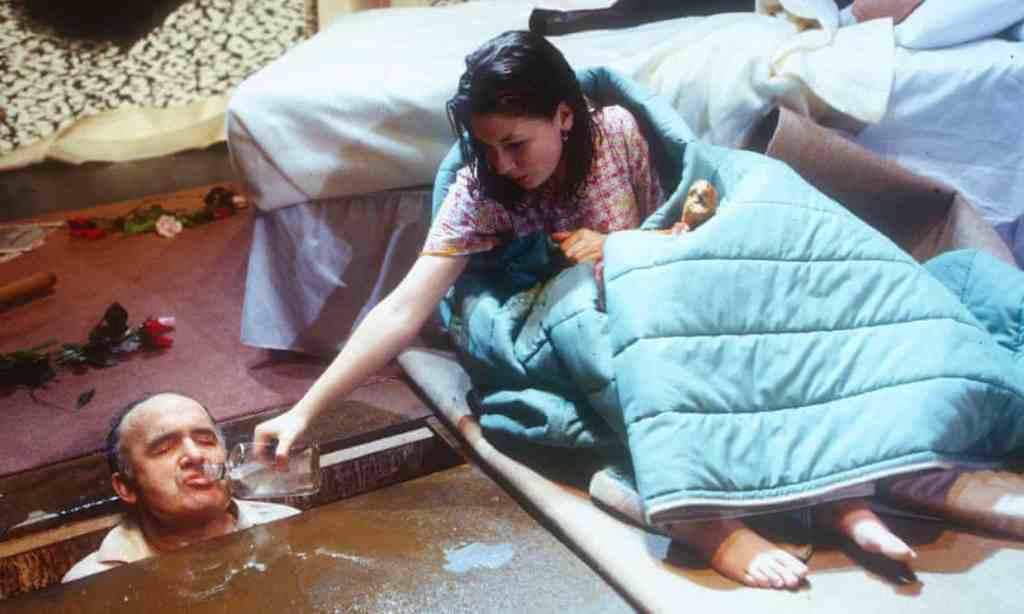
Blasted is about the impacts of war on the regular being, inspired by the 1990’s Bosnian War. It opens in a Leeds hotel room, and what follows is a series of events drawing together the normalisation of gendered violence and predation in the abusive companionship of the two protagonists, with the looming external presence of global conflict. Violence in Blasted was never suggestive, but authentically gruesome. Kane de-glamorised violence, and herself said that ‘the representation of violence caused more anger than actual violence.
In an interview with Dan Rebellato, Kane discussed how the reviewers rarely discussed the quality or stylistic choices within her work. Instead, they recounted the plot and the play’s most gory moments. She was unfairly labelled with sensationalism, rather than the acknowledgement that her work toyed with harsh realities and western ignorance.
In 2001, two years after Kane’s suicide, Blasted was revived. This time, it received critical acclaim. Those who had previously been shocked at its excesses now paid tribute to them. Sarah Kane, as one of the only female theatre makers of the male heavy ‘in-yer-face’ movement, became a genius.
Rosemary Waugh’s Running the Room, a compilation of interviews with women theatre directors, includes an interview with Katie Mitchell. In this interview, she discusses the restrictions places on women creatives in the theatre space, and how gender can inhibit the work they decide to put on.
“The higher up you go, the clearer that is. Gender is often a feature of why women get jobs and why women don’t get jobs, and it can determine the type of productions a woman can make.”
Sarah Kane’s work was, in the eyes of the press, unacceptably out of the ordinary. These attitudes towards theatrical taboo still hold. Famously, audiences in 2016 booed Katie Mitchell’s production of Lucia di Lammermoor after her addition of an authentic miscarriage, as well as a staging of the stabbing of Lucia’s husband, something that historically happened away from the audience’s view. These additions were intended to add more depth to the opera’s women, giving them as much character development as the men.
At the tail end of 2023, Mitchell spoke at the Goethe Annual Lecture, criticising the ‘misogyny and rage’ of British theatre critics. She discussed feelings of restraint and straightjacketing by Britain’s theatre scene. Mitchell’s argument sits primarily in Britain’s need to honour the work of the original writer, something she found restrictive. She argues that there is no point following the wishes of a misogynistic author while directing.
If we think back to that episode of Friends now, the argument seems closer to our reach. Why are women, still, shunned for stepping out of the ordinary? There is a distinctive air of the male gaze in the critiques of these works. Why shouldn’t we showcase the truths of a predatory relationship? Why should a stabbing, crucial to a female character’s development, have to happen out of the view of the audience?
Why, all these years later, are these reactions and experiences still the same?
These press reactions (or in some cases, their false portrayals of audience reactions) are attacks on the courage it takes to create theatre that leaves behind boundaries formed under the complex histories and ownerships of a patriarchal industry. When we attack the breaking of boundaries, we attack those who dare to break them.
The 20th anniversary edition of The Vagina Monologues has ‘Vagina Facts’ woven between entries, the first being a direct quotation from The Women’s Encyclopedia of Myths and Secrets, it reads:
‘At a witch trial in 1593, the investigating lawyer (a married man) apparently discovered a clitoris for the first time; [he] identified it as a devil’s teat, sure proof of the witch’s guilt. It was ‘a little lump of flesh, in a manner sticking out as if it had been to a teat, to the length of half an inch,’ which the gaoler, ‘perceiving at the first sight thereof, meant not to disclose, because it was adjoining to so secret a place which was not decent to be seen. Yet in the end, not willing to conceal so strange a matter,’ he showed it to various bystanders. The bystanders had never seen anything like it. The witch was convicted.’

 OFF BOOK.
Leave a comment